How to Troubleshoot No Crank Fast

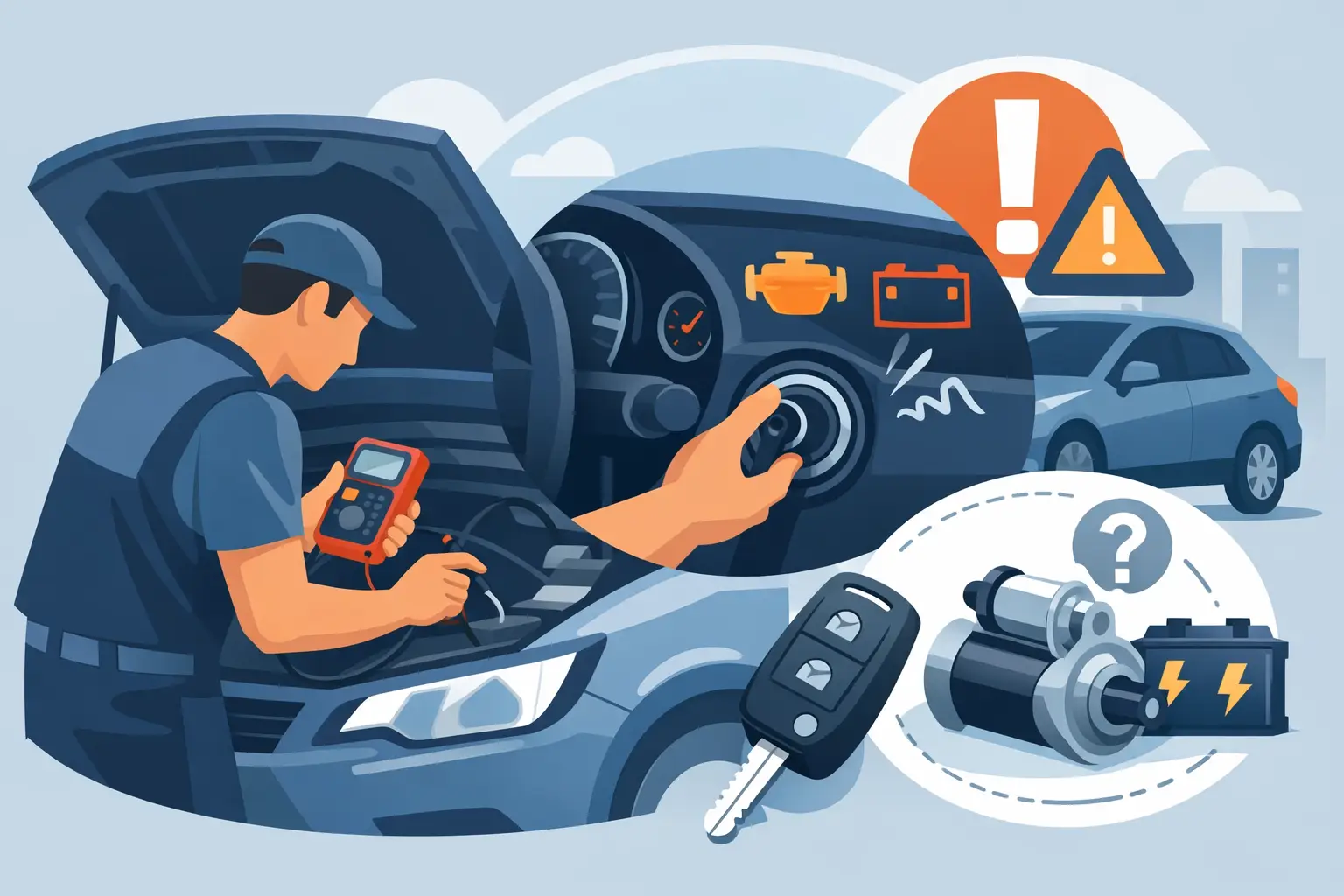
A no-crank vehicle usually shows up at the worst time – key on, dash lights up, maybe a click, maybe nothing, and the engine never turns. If you need to know how to troubleshoot no crank without wasting time or replacing parts blindly, the fastest path is a voltage-drop-first, circuit-based approach.
The mistake that slows most no-crank jobs is treating every case like a bad starter. Sometimes it is. Just as often, the fault is upstream: battery state of charge, cable resistance, a failed park/neutral input, an immobilizer issue, a relay control problem, or missing power at the solenoid S terminal. The symptom is simple. The cause is not always simple.
Start with symptom definition before you troubleshoot no crank
“No crank” means the starter does not rotate the engine. That is different from a slow crank, and very different from a crank-no-start. If the engine turns over normally but will not run, you are in fuel, spark, timing, or security territory. If the starter engages weakly and drags, you still need to inspect the high-current side, but battery condition and voltage drop move to the top of the list.
A true no-crank complaint usually falls into one of three buckets. You get nothing at all. You get a single click or repeated clicking. Or you get a relay click underhood with no starter response. Each pattern matters because it tells you where to test next.
The fastest workflow for how to troubleshoot no crank
Start at the battery, then move through the high-current path, then the control side. That order prevents guesswork.
Check battery voltage under real conditions
A battery reading 12.6 volts at rest can still fail under load. Verify open-circuit voltage first, then watch battery voltage during a crank attempt. If voltage collapses hard, the battery may be discharged, sulfated, or there may be excessive resistance in the cable connections. If the battery stays reasonably stable but the starter does nothing, that points you farther down the circuit.
Do not stop at the battery posts. Check the terminal ends too. A clean-looking connection can still be loose between the lead terminal and the post. Testing post-to-terminal voltage drop during a crank attempt is faster than removing parts based on appearance alone.
Inspect cable condition and grounds
Bad cables cause a surprising number of no-crank complaints, especially on older trucks, rust-belt vehicles, and anything with heat-soaked battery routing. Check the positive cable from battery to starter and the ground path from battery to engine block and chassis. Corrosion under insulation, loose eyelets, damaged fusible links, and poor engine ground straps can all stop starter operation.
Voltage drop testing is the cleanest way to prove the cable path. On the positive side, measure from battery positive post to the starter B+ terminal during crank request. On the ground side, measure from battery negative post to the starter housing or engine block. High readings tell you resistance is eating the available voltage. That is more useful than a continuity check on a static circuit.
Verify the starter main feed is present
The starter B+ terminal should have battery voltage all the time. If it does not, stop there. You may have an open cable, blown mega fuse, fusible link failure, or a distribution problem at the underhood power center. There is no point chasing control signals until the starter has a solid main feed.
If B+ is present, move to the solenoid control terminal. This is where the job usually gets faster.
Test the S terminal before condemning the starter
When the key is turned to START, or the push-button system requests crank, the starter solenoid S terminal should receive a control voltage signal. If that signal is present and the starter does not engage, the starter or solenoid is highly suspect. If the signal is missing, the fault is upstream.
That one test splits the system in half. It keeps you from replacing a starter when the real fault is the relay, ignition switch, transmission range switch, clutch switch, body control module logic, or theft deterrent system.
There is some vehicle variation here. Older systems may route the start request directly through the ignition switch and park/neutral or clutch switch. Newer vehicles may use modules to authorize crank. The principle stays the same: does the starter receive the command or not?
Control-side faults that cause no crank
Once you know the starter is not getting the command, follow the control circuit logically.
Starter relay problems
Many no-crank faults end up at the relay, but not always because the relay itself is bad. You need to verify relay feed, relay ground, load-side power, and control-side activation. One side of the relay may have constant battery voltage, while the other side receives ignition-switch or module control. If the relay clicks, that helps, but it does not prove the load contacts are passing current.
A relay can click and still fail under load. It can also test fine on the bench and fail installed due to heat or low control voltage. Swapping with a known-good matching relay can be useful, but meter-based confirmation is better.
Park/neutral switch or clutch switch faults
Automatic transmission vehicles need a valid park or neutral input. Manual transmission vehicles need a working clutch interlock. If the vehicle starts in neutral but not park, or starts with clutch pedal movement or extra pressure, you already have a direction.
These switches can fail mechanically, electrically, or through adjustment drift. On newer systems, the transmission range information may be carried through a module network, so scan data matters as much as direct circuit testing.
Ignition switch and start request issues
On older vehicles, the ignition switch may directly power the start circuit. On newer ones, it may only send a low-current request to a module. If the switch does not produce the proper start signal, the rest of the system never wakes up.
This is where exact wiring diagrams matter. You need to know whether the switch output should feed a relay, a BCM, an ECM, or a security module. Guessing at wire function by color alone is a good way to lose time.
Immobilizer or anti-theft lockout
A security-related no-crank is easy to misread if you focus only on the starter. Some systems disable injector pulse but still allow crank. Others block relay activation or starter authorization entirely. Watch the security indicator and check scan data for start enable status where available.
If the anti-theft system is active, replacing the battery or starter will not fix the complaint. You need to resolve the authorization issue first.
When the starter is the problem
If the starter has full-time B+, a clean ground path, and receives the crank command at the S terminal but does not engage, the starter assembly is the likely failure point. Heat soak, worn solenoid contacts, internal dead spots, and high current draw are common causes.
A bench test can help, but installed-circuit results matter more. Some starters spin fine unloaded on the bench and still fail under engine load. If you have excessive current draw with little or no starter movement, internal starter failure is likely. If current draw is low and the unit does nothing despite proper command and feed, the solenoid may not be closing the internal contacts.
Why no-crank diagnosis depends on vehicle information
This is where generic advice starts to break down. A 2004 Silverado, a late-model BMW, and a Toyota hybrid with starter-control logic do not follow the same exact path. Fuse naming changes. Relay locations change. Start authorization changes. Wire colors and connector pinouts change. On many vehicles, even identifying the right test point quickly depends on having the correct diagram in front of you.
For technicians and advanced DIY users, the real speed gain comes from matching the symptom to the exact circuit layout for that make and model. If you are tracing a no-crank issue through relay control, range switch inputs, or BCM authorization, vehicle-specific wiring documentation is what keeps the job efficient. AutoCarData is built around that need – buy and download the diagrams you need, then test the circuit instead of guessing at it.
Common mistakes that waste time on a no-crank job
The biggest one is replacing the starter before checking for an S-terminal command. The second is assuming a good battery because the lights work. Headlights and dash lamps do not prove the battery can support starter load. Another common mistake is skipping ground-side testing. Techs often focus on the positive cable and forget that a poor engine ground can stop the whole system just as effectively.
There is also the scan tool trap. Scan data is useful, especially on newer vehicles, but it does not replace voltage checks. A module can show a valid start request while the relay output never reaches the starter because of resistance, poor terminal tension, or a damaged wire.
A practical decision point
If you want the shortest version of how to troubleshoot no crank, it is this: confirm battery condition, confirm voltage at starter B+, confirm ground integrity, then check for crank command at the S terminal during a start request. Those four checks tell you whether to stay at the starter or move upstream into relay, switch, module, or security diagnostics.
That approach works because it follows the circuit, not the guess. When the vehicle will not crank, the cleanest repair path is usually the one that starts with exact electrical information and a meter, not a parts order.