How to Diagnose Parasitic Draw Fast

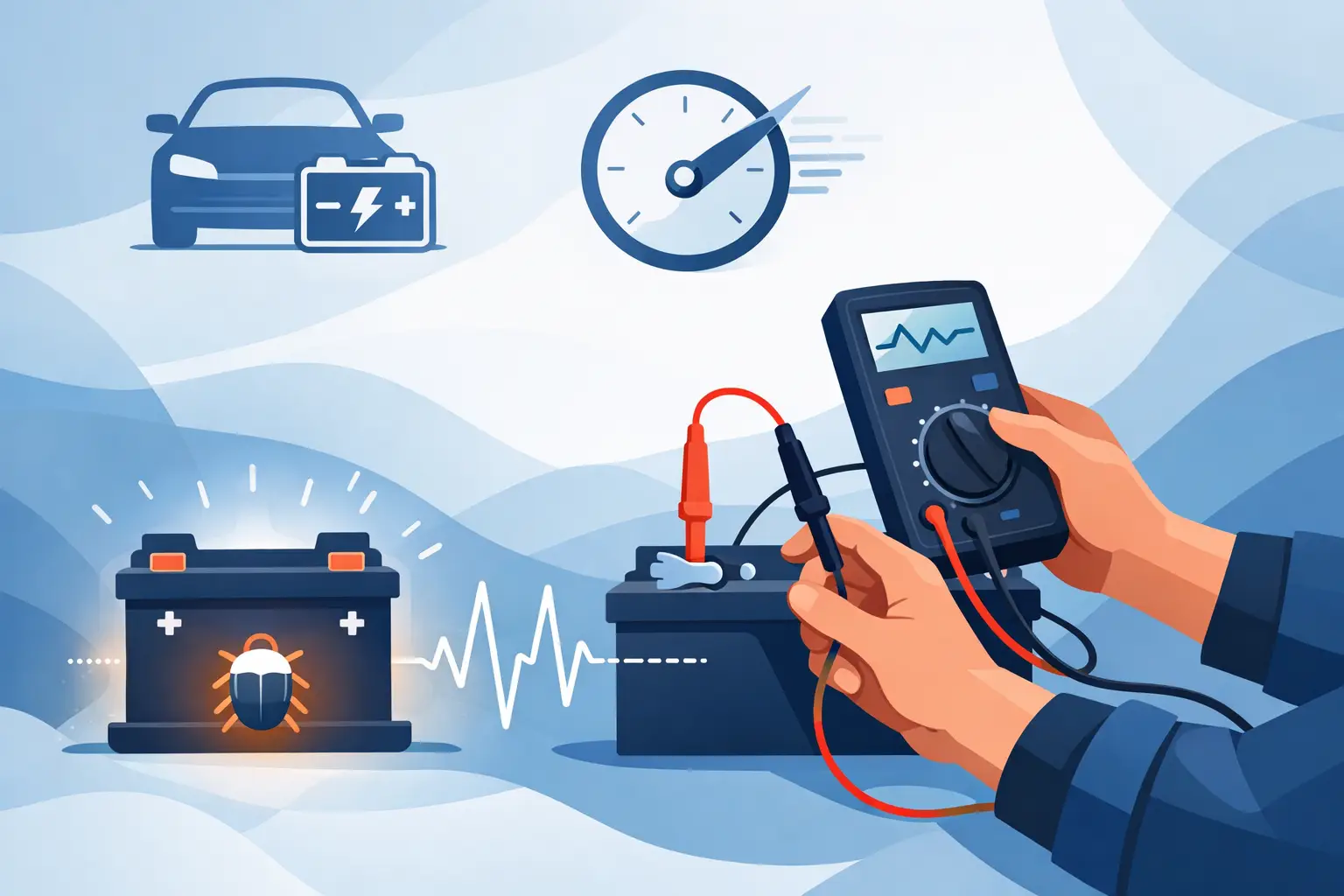
A battery that tests good, charges fine, and still goes dead overnight usually points to one thing: you need to know how to diagnose parasitic draw without guessing. Random parts swapping wastes time. The right process gets you from dead battery complaint to the exact circuit, component, or module that is staying awake.
Parasitic draw testing is simple in principle and easy to get wrong in practice. Modern vehicles have multiple control modules, retained accessory power, telematics, security systems, and sleep timers. If you connect your meter too early or open the wrong door at the wrong time, you can create the very draw you are trying to measure.
What parasitic draw actually means
Every vehicle has some key-off current draw. Memory for the PCM, radio presets, anti-theft systems, and body control modules all need a small amount of power. That is normal. A parasitic draw becomes a problem when key-off current stays above spec long enough to drain the battery.
On many vehicles, a normal fully asleep draw may land somewhere around 20 to 50 milliamps, though some late-model vehicles can be a little higher depending on factory equipment. The number that matters is the manufacturer spec for that exact make and model. If you are working blind without wiring data or service information, you are already behind.
Before you start the test
If you want to diagnose parasitic draw correctly, verify the basics first. A weak battery, charging problem, or poor cable connection can mimic a draw complaint. Load-test the battery, confirm charging voltage, and inspect terminals and grounds. If the battery itself cannot hold a charge, current draw testing will send you in the wrong direction.
You also need to know whether the customer complaint is overnight drain, multi-day drain, or intermittent no-start after sitting. That changes your expectations. A 120 mA draw may kill one vehicle in a day and another in several days depending on battery condition, reserve capacity, and ambient temperature.
The basic tools are straightforward: a quality digital multimeter with an amperage function, a low amp clamp if you have one, fused jumper leads, and vehicle-specific wiring diagrams. A thermal camera can help in some cases, but it is not a replacement for actual current measurement.
Set the vehicle up so modules can go to sleep
The setup is where most mistakes happen. Turn everything off, remove the key or fob from the vehicle area if required, and close all latches. If you need a door open for access, manually latch the striker so the body control module thinks the door is shut. Hood and trunk switches matter too.
Many vehicles need 15 to 45 minutes to enter sleep mode. Some need longer. If you disconnect the battery, use a memory saver only if the vehicle allows it and only if it will not interfere with the test. On some platforms, preserving memory keeps modules awake longer. It depends on the system design.
Measuring key-off current the right way
The classic method is to place an ammeter in series with the battery cable, usually on the negative side. Do not just pull the cable off and jam the meter in line. That can wake modules, blow the meter fuse, or lose valuable test conditions.
A better method is to install a jumper lead between the negative battery post and the negative cable first. With the jumper carrying current, disconnect the cable from the battery post. Then connect the meter in parallel to the jumper. Once the meter is stable and set to the correct amp range, remove the jumper so current flows through the meter.
Watch the reading over time. It may start high and gradually step down as modules time out. That is normal. What you want is the stabilized draw after the full sleep period. If it settles at 25 mA on a vehicle spec’d for 35 mA, there is no parasitic drain issue. If it sits at 180 mA, now you have something to isolate.
A low amp clamp can be safer and faster because it avoids disconnecting the battery. The trade-off is accuracy. Cheap clamps often do not resolve very low current well enough to separate a normal 30 mA draw from a problem at 80 mA. For precision, an in-series meter is still the standard.
How to isolate the circuit causing the draw
Once excessive current is confirmed, isolate the draw by pulling fuses one at a time while watching the meter. When the reading drops significantly, you have found the affected circuit branch. This is where a fuse layout and wiring diagram save time.
Do not yank every fuse randomly. Start with the fuse panels tied to body electronics, infotainment, retained accessory power, interior lighting, telematics, and convenience modules. On newer vehicles, multiple modules may share power feeds, so one fuse drop does not always mean one bad part. It tells you where to look next.
If pulling a fuse drops current from 220 mA to 30 mA, that circuit is the problem area. From there, use the wiring diagram to identify all loads and splice paths on that feed. Then disconnect components on that branch one by one until the draw disappears.
Some drains are not on a fused branch you expect. Alternators are a common example. A leaking diode can create battery drain with the engine off. If fuse pulling does not isolate the problem, disconnect the alternator B+ cable and connector safely and recheck current. Aftermarket accessories are another frequent source, especially remote starts, dash cams, audio amplifiers, GPS trackers, and alarm systems.
Why module sleep behavior complicates testing
Modern vehicles do not all behave the same way. Some modules wake up when they see bus traffic, battery reconnect, key proximity, hood opening, or even movement near the vehicle. That means your test process can create false readings.
If current spikes after you touch the car, wait again and let it settle. If a draw appears intermittent, use meter min/max recording or a data logger. Some failures only show up when a relay sticks, a telematics unit pings, or a control module fails to time out. These are harder to catch with a quick static reading.
This is also why service information matters. Factory sleep times, known wake triggers, and module power-down sequences are not guesswork items. If you have exact wiring and chassis documentation, you can see which modules share keep-alive feeds, where splice packs are located, and how grounds are distributed. That shortens diagnosis fast. If you need make-specific diagrams, AutoCarData provides downloadable repair documentation you can use right away.
Common parasitic draw sources
Interior, glove box, trunk, and underhood lights still cause battery drains more often than people admit, especially when switches misadjust or LED retrofits are wired poorly. Relays that stick closed can keep loads powered long after key-off. HVAC control modules, seat modules, door modules, and infotainment units are regular offenders on certain platforms.
Charging system faults matter too. An alternator with a bad diode may drain the battery and also create AC ripple issues while running. Then there are network problems: one module fails internally and keeps the CAN bus awake, which prevents several other modules from sleeping. In that case, the current draw is a symptom, not the root cause.
Aftermarket equipment deserves extra suspicion. If the problem started after an audio install, remote starter, trailer brake controller, or camera setup, inspect that work first. Poor power sourcing and constant-hot connections are common.
What not to do during a parasitic draw test
Do not open doors, switch the ignition on, or wake the vehicle unless the test step requires it. Do not crank the engine through a meter set on the milliamp or low amp scale. Do not assume every vehicle should be under 50 mA. Some are, some are not. Use the published spec.
Also avoid declaring victory too early. If the draw disappears after a fuse pull, reinstall the fuse and confirm the draw returns. Then isolate loads on that branch. The goal is not just finding a fuse that changes current. The goal is finding the failed component, relay, wiring issue, or module behavior causing it.
When the draw is real but the fix is not obvious
Sometimes the final answer is not a failed hard part. A software issue can prevent sleep mode. A door latch switch may falsely report open status. Corrosion in a connector can backfeed a circuit. A damaged wire can keep a relay energized. These faults do not always reveal themselves with a quick continuity check.
That is where exact circuit tracing matters. Follow the power path, the wake-up inputs, the grounds, and the shared module feeds. Compare actual behavior to the diagram, not to assumptions. Electrical diagnosis gets expensive when the process is loose.
If the battery goes dead and the charging system checks out, treat the draw test like a controlled measurement, not a fishing trip. Get the vehicle to sleep, measure current correctly, isolate the circuit methodically, and verify the repair under the same conditions that caused the complaint. That is how you stop a comeback before it starts.