What Is CAN Bus in a Car?

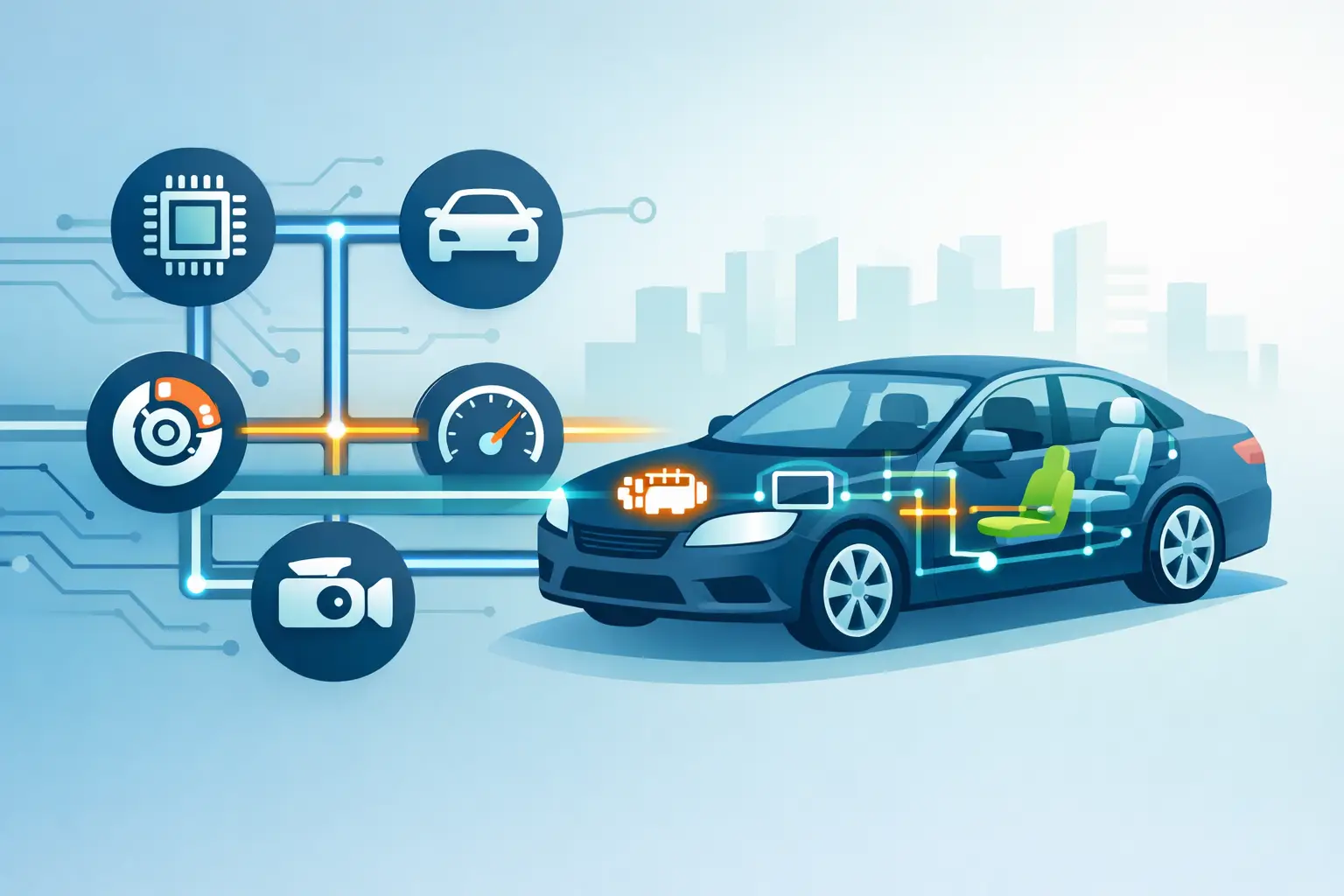
A no-communication fault, multiple warning lights, and a scan tool that suddenly cannot see half the modules – that is usually when the question comes up: what is CAN bus, and why does one network problem shut down so much of the vehicle?
In simple terms, CAN bus is the communication system that lets electronic control modules talk to each other over a shared pair of wires. Instead of running a separate wire from every switch and sensor to every module that needs the signal, the vehicle sends data messages across the network. The engine control module, ABS module, airbag module, body control module, transmission control module, instrument cluster, and many other units can all exchange information quickly and reliably.
For anyone doing electrical diagnosis, this is not theory. If the CAN network is down, systems that are mechanically fine can stop working because they are no longer receiving the data they need.
What is CAN bus and what does it do?
CAN stands for Controller Area Network. It was developed to reduce wiring complexity and improve communication between vehicle electronics. In older designs, adding a new feature often meant adding more point-to-point wiring. That increased weight, cost, and failure points. CAN changed that by letting multiple modules share the same communication path.
A module does not need a direct wire to every other module. It sends a message onto the bus, and any module programmed to use that message can read it. For example, the engine control module may broadcast engine speed, coolant temperature, or throttle position. The instrument cluster, transmission controller, or stability control system can use that same data without separate dedicated circuits for each one.
That is why one missing message can create several symptoms at once. If wheel speed data is not available, ABS, traction control, and transmission behavior may all be affected. If the body control module loses network communication, you can see problems with lighting, door functions, security, or even a no-start condition on some platforms.
How CAN bus works in practical terms
Most CAN systems use two communication wires called CAN High and CAN Low. These wires are twisted together to reduce electrical interference. Messages are sent as differential signals, meaning the voltage difference between the two wires carries the information. That design helps the network stay reliable in a noisy electrical environment.
Under normal operation, both lines sit near a bias voltage and move in opposite directions when data is transmitted. Because modules look at the difference between the two wires, CAN is more resistant to interference than a single-wire setup. That matters in a vehicle packed with ignition noise, motors, relays, charging system activity, and aftermarket accessories.
The network also uses terminating resistors, typically at each end of the bus. On many high-speed CAN systems, you will measure about 60 ohms across CAN High and CAN Low with power off if the network and both terminating resistors are intact. That quick check is useful, but it is not enough by itself. A correct resistance reading does not prove the network is healthy under load.
Messages on the bus are prioritized. Critical data gets higher priority so it can win access to the network first. That is one reason CAN works well for real-time vehicle control. Brake and powertrain data cannot wait behind less important convenience messages.
Why modern vehicles depend on it
A current vehicle can have dozens of modules. Without a network like CAN, wiring would be much heavier and system integration would be harder to manage. Features that technicians now take for granted depend on shared data.
The transmission may need engine torque information before shifting. The steering system may need vehicle speed. The HVAC control head may need ambient temperature data from another module. The instrument cluster may display warnings based on messages from the ABS, SRS, or engine control module.
This shared architecture improves efficiency, but it also creates dependency. A single module shorting the network can take down unrelated systems. A damaged twisted pair in one section of the harness can block communication for multiple modules. That is why network faults can look bigger than they are.
High-speed CAN vs low-speed CAN
Not all CAN networks in a vehicle serve the same purpose. Many vehicles use more than one CAN network, and understanding that matters during diagnosis.
High-speed CAN is commonly used for powertrain, ABS, steering, and other time-critical systems. It operates faster and is less tolerant of message delays. Low-speed or medium-speed CAN is often used for body and convenience functions such as doors, seats, lighting, climate control, and similar systems.
Some vehicles also use gateways to connect different networks. The gateway manages traffic between systems that operate at different speeds or use different communication protocols. If the gateway fails, it can look like several modules failed at once. In reality, they may still be working on their own side of the network but unable to pass data across the vehicle.
What CAN bus problems look like
When CAN bus faults show up, the symptoms are often wider than the actual failure point. You may see a no-start, no-crank, intermittent stalling, inoperative gauges, warning lamps, transmission default mode, power steering issues, or scan tool communication failures.
A common pattern is one fault creating a long list of U-codes. Those are network communication diagnostic trouble codes. The key is not to treat every code as a separate failure. In many cases, several modules are simply reporting that they cannot hear from one specific control unit, or that the bus itself is unstable.
Intermittent faults are common. A harness rubbed through near a bracket, water intrusion in a connector, a corroded splice, or a failing module can disturb communication only under vibration, temperature change, or load. That is why a vehicle may act normal in the bay and fail on the road.
Basic CAN bus diagnosis
The first step is to identify the network layout for the exact vehicle. Guessing wire colors, splice locations, or module pinouts wastes time. This is where make-specific wiring diagrams and module communication schematics matter.
Start by checking whether the scan tool can communicate with all modules, some modules, or none. If only one module is offline, focus on that module’s power, ground, and network connections. If multiple modules are missing, look for a shared network issue, gateway issue, fuse problem, or shorted module.
Next, verify powers and grounds before condemning the network. A module that has lost ignition feed or ground may appear to be a CAN problem when it is really a basic supply fault. After that, check network resistance with the system powered down if the service information supports it. Then move to live signal testing with a lab scope when possible. A scope gives a much better picture of bus activity, distortion, and dropout than a simple meter.
Disconnecting modules one at a time can help isolate a shorted control unit, but this only works well when you know the network topology. On some vehicles, unplugging the wrong connector can add confusion or split the network in a way that changes the symptom.
Why wiring information matters more than generic advice
CAN bus theory is useful, but repairs happen at the connector, splice, module, and harness level. You need the correct diagram for the exact year, make, model, and system.
Wire colors can vary. Splice packs may be hidden in different locations. Gateway modules may be integrated into another control unit. Some vehicles use star connectors for certain low-speed networks, while others route communication differently. Termination resistor placement also depends on the platform.
That is why technicians working network faults rely on accurate schematics, connector views, and chassis wiring data. Generic online answers may tell you what CAN bus is, but they will not tell you where CAN High changes color under the dash or which branch connector feeds the rear body module.
For repair work, that difference matters. Fast access to the right documentation shortens diagnosis, reduces unnecessary parts replacement, and makes it easier to confirm the fault before you start opening harnesses.
What is CAN bus worth knowing as a technician?
The practical answer is this: CAN bus is the backbone of communication between vehicle modules, and when it fails, symptoms spread across multiple systems fast. Understanding the network helps you avoid chasing parts and start testing the circuit path that actually carries the problem.
If you are dealing with communication codes, missing modules, or electrical problems that do not make sense system by system, stop treating each symptom in isolation. Get the wiring, identify the network, and test it like a shared circuit. That is usually where the repair starts moving again.